Leadership Overview

Agentic SDLC

A Slack-first delivery operating model where AI agents
help teams move work from idea to production

Clearer handoffs. Stronger governance. Measurable delivery flow.
Humans approve decisions. Agents do the repeatable work.

What This Is

A structured collaboration layer, not "AI replacing engineers"

Agentic SDLC is a governed, Slack-first delivery operating model where AI agents help teams move work from idea to production with clearer handoffs, stronger governance, and measurable delivery flow.
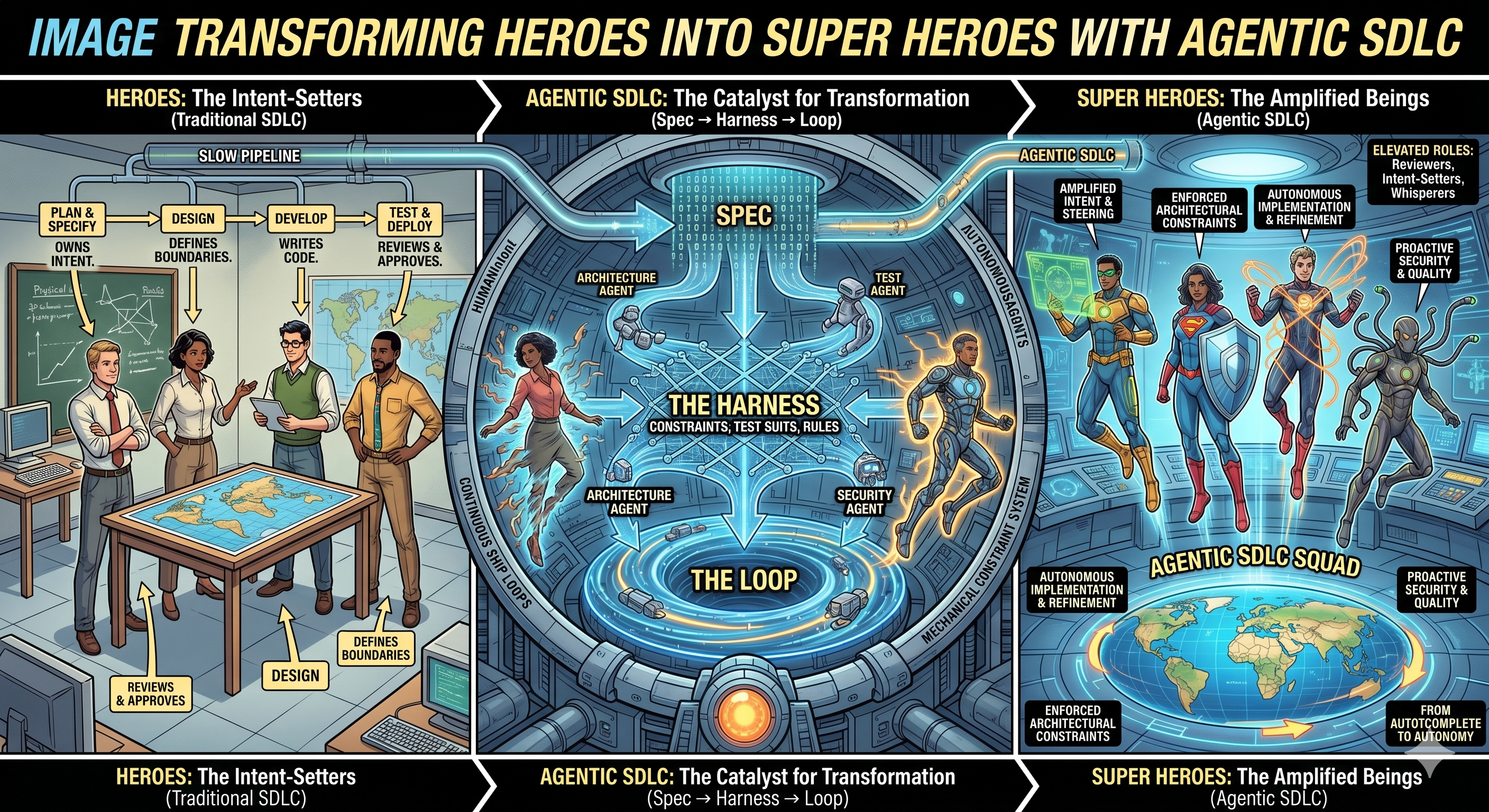
Agentic SDLC transformation overview

Agentic SDLC — end-to-end transformation view

Agents Do Repeatable Work

Requirements formatting, design checklists, test case authoring, coverage checks, status updates, and handoff preparation.

Humans Approve Key Decisions

Business scope, architecture, release gates, production deploys, and incident response stay under human control.

Every Stage Leaves a Trail

Auditable evidence in Slack Canvas, GUS, GitHub, and structured telemetry for process improvement.

The goal: reduce coordination drag, improve quality, and make delivery measurable end to end.
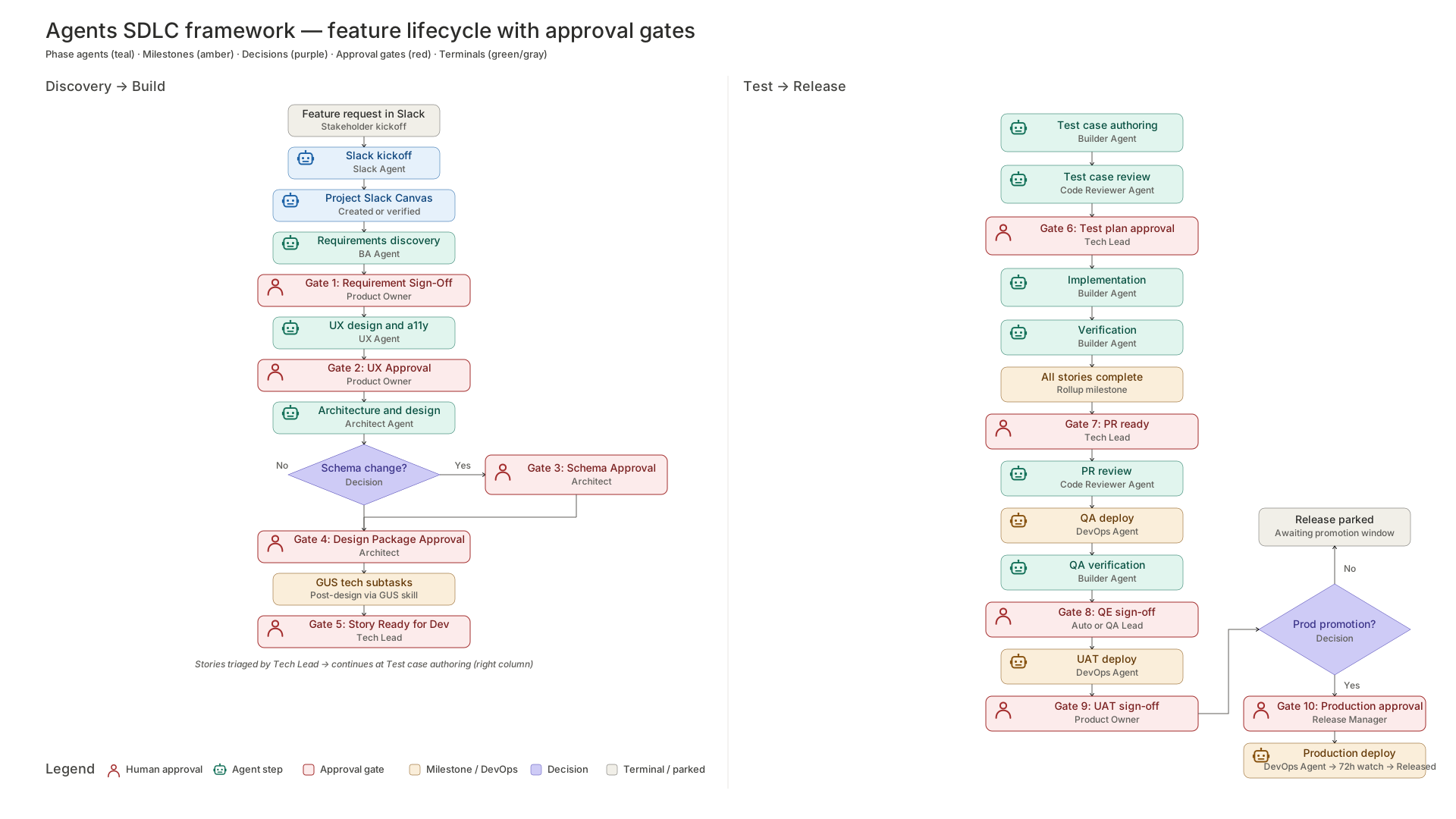
Agentic SDLC Flow

From idea to production — agents, gates, and evidence in one picture

Agentic SDLC end-to-end flow diagram with stages, agents, and gates

Agentic SDLC end-to-end flow — stages, agent ownership, human gates, and cross-cutting services

Requirements & UX
Design & Planning
Build, Verify & Review
Release & Operate
Stages
9
Discovery → Monitor
Human Gates
11
Approvals & incident gates
Cross-cutting
4
Slack • GUS • Salesforce • Judge
Evidence Surfaces
6+
Canvas • GUS • GitHub • telemetry

End-to-End Lifecycle

9 stages, 11 human gates, 4 cross-cutting services — MVP delivery status

MVP Status: ✓ Stages 1–7 Complete ⚙ Stages 8–9 In Progress
1
📚
Discovery
BA Agent
✓ MVP
2
🎨
UX Design
UX Agent
✓ MVP
3
🛠
Architecture
Architect Agent
✓ MVP
4
Test Design
Builder Agent
✓ MVP
5
💻
Implement
Builder Agent
✓ MVP
6
Verify
Builder Agent
✓ MVP
7
🔍
Code Review
Reviewer Agent
✓ MVP
8
🚀
Deploy
DevOps Agent
⚙ In Progress
9
📈
Monitor
SRE Agent
⚙ In Progress
Requirements & UX
Design & Planning
Build, Verify & Review
Release & Operate
MVP Complete
In Progress
Human Approval Gates
🔒 G1 Requirement Sign-Off
🔒 G2 UX Approval
🔒 G3 Design approval
🔒 G4 Schema approval
🔒 G5 PR review
🔒 G8 QE Sign-off
🔒 G7 Prod approval
🔒 G8 Production sanity
🚨 G11 Incident Mitigation
🚨 G12 Incident Closure
🔒 G13 Postmortem / Release Retro
Cross-cutting
Slack Agent — collaboration & gates
GUS Agent — work management
Salesforce Agent — SF coordination
Judge Agent — quality sidecar
IDE
Claude CodeCursorCodex — developer environment & agent orchestrator
Skills
sdlc-core • gus • slack-workflow • process-telemetry • agentic-testing • ux-design • sf-apex • sf-lwc • fullstack-* • aws-cloud • qe-* • mermaid-diagrams
MCPs
GitHubSlackSalesforce • Confluence • SonarQube • Jenkins
Evidence
Slack Canvas • GUS • Project Canvas • Repo test catalog • PR reviews • .asdlc/ telemetry • docs/evidence

Design Principles

The choices that make this framework trustworthy at scale

Slack-First, Not Terminal-First

Humans see status, gates, blockers, and next actions in the collaboration channel. Leaders don't need IDE access.

Canvas as Project Memory

Channel scroll is not the source of truth. Canvas is the living project brief with current phase, decisions, and evidence.

Human Gates Remain Explicit

Agents do not silently proceed after approval. The completion card names who triggers the next stage and how.

Clear Role Boundaries

Architect designs. Tech Lead estimates. Builder implements and verifies. Reviewer reviews. Release Manager approves.

Durable, Sanitized Evidence

Local scratch files are not approval artifacts. Evidence lives in Canvas, GUS, GitHub, and structured telemetry.

Semantic Telemetry

Events describe the SDLC process, not raw logs or private data. Enables process mining without security risk.

Scoped Tool Access

Each agent uses only the MCP integrations needed for its role. No agent has blanket access to all systems.

Optional Skills by Scope

Agents load domain knowledge on demand. Simple work doesn't carry the weight of every Salesforce or AWS rule.

Judge Agent Evaluation core-suite • 2026-05-01

Automated contract, artifact, and governance evaluation across 9 in-scope agents

Score
82/100
Pass with risk
Cases
17/17
12 mandatory + 5 negative
Findings
0 / 0 / 5
critical / major / minor
Scope
9
agents (DevOps & SRE excluded)

Scoring Dimensions

Security & redaction
15 / 15
Gate / Canvas / telemetry
17.5 / 20
Artifact completeness
15 / 20
Routing & context
13.1 / 15
Agent contract & skills
13.1 / 15
Domain judgment
7.5 / 10
Collaboration clarity
3.8 / 5
Total: 82 / 100

5 Minor Findings

1
ORCH-TEL-001
Orchestrator
Only agent without a "You own:" telemetry block — events referenced in prose but break the pattern
2
DESIGN-SKILL-001
Architect
Required/optional skill split flattened into a single list in ARCHITECTURE.md and README.md
3
GUS-SKILL-001
GUS Agent
Requires Slack MCP and posts to Slack, but slack-workflow skill not listed
4
BUILDER-HND-001
Builder
No formal handoff payload field list, unlike Architect's 15-field enumeration
5
BUILDER-CRD-001
Builder
3 inline Slack templates instead of referencing completion card catalog IDs

Why not Pass (85+)?

Artifact completeness (weight 20) and domain judgment (weight 10) lost partial credit from the Builder handoff gap, card catalog disconnect, and GUS Agent's lighter contract. Orchestrator telemetry gap cost partial credit on gate/handoff/telemetry discipline.

Recommended Prioritization

1.
ORCH-TEL-001 + BUILDER-HND-001 — contract completeness for downstream agents
2.
BUILDER-CRD-001 — simple catalog reference fix
3.
GUS-SKILL-001 — decide if intentional or oversight
4.
DESIGN-SKILL-001 — documentation consistency
DEMO

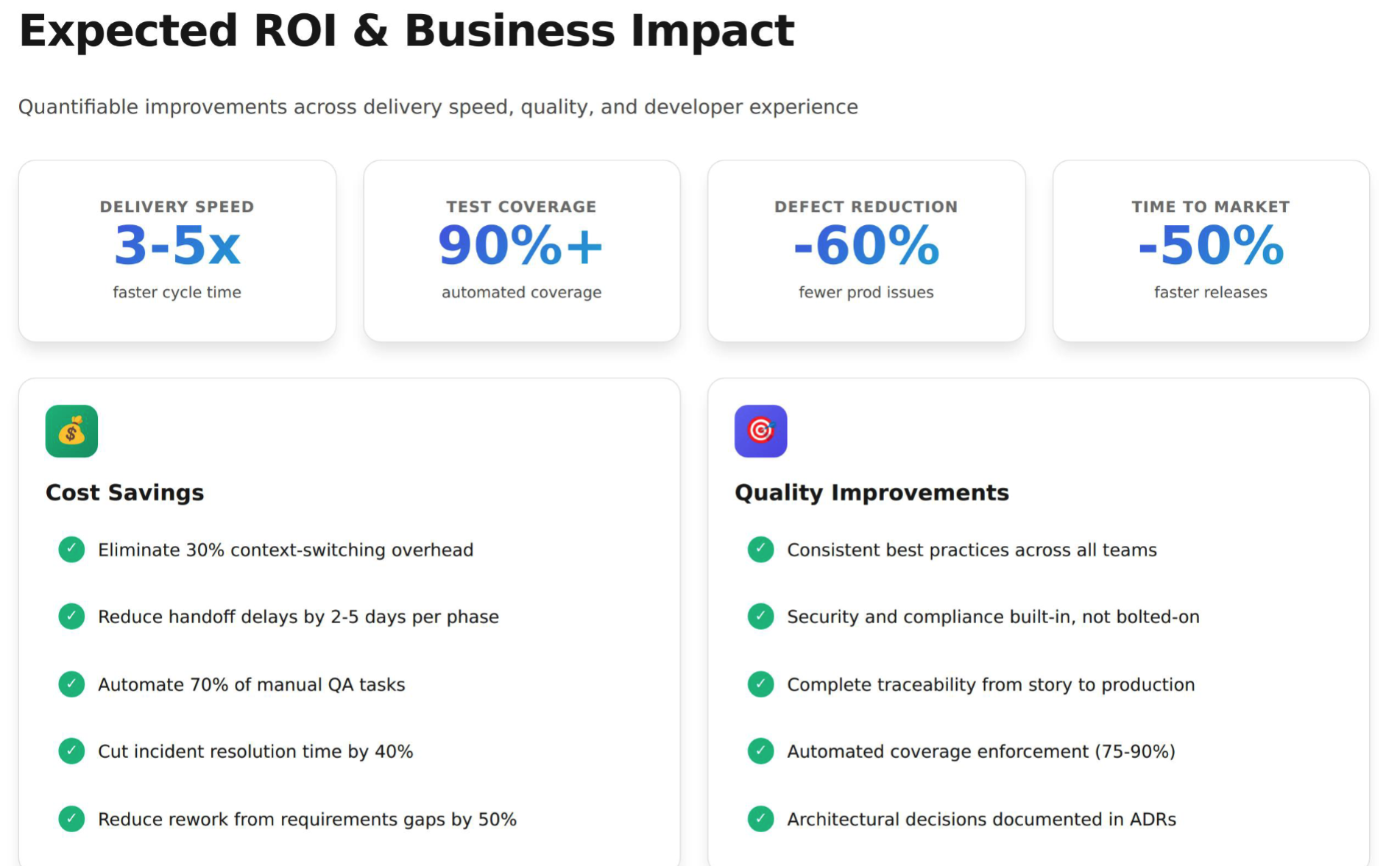
Expected ROI & Business Impact

Quantifiable improvements across delivery speed, quality, and developer experience

Expected ROI & Business Impact: 3-5x faster cycle time, 90%+ test coverage, -60% defect reduction, -50% time to market, plus cost savings and quality improvements

Modeled on Agentic SDLC pilot telemetry and industry benchmarks for AI-assisted delivery

Speed

3–5x faster cycle time and 50% faster releases — from kickoff to production, with handoff waste removed.

Quality

90%+ automated coverage and 60% fewer prod issues — gates enforce quality, traceability runs from story to production.

Cost

Eliminate 30% context-switching, automate 70% of manual QA, and cut incident resolution by 40%.

The headline: the same team ships more features, with fewer defects, in half the time — and every gate, decision, and approval is captured for audit by default.

North Star Vision

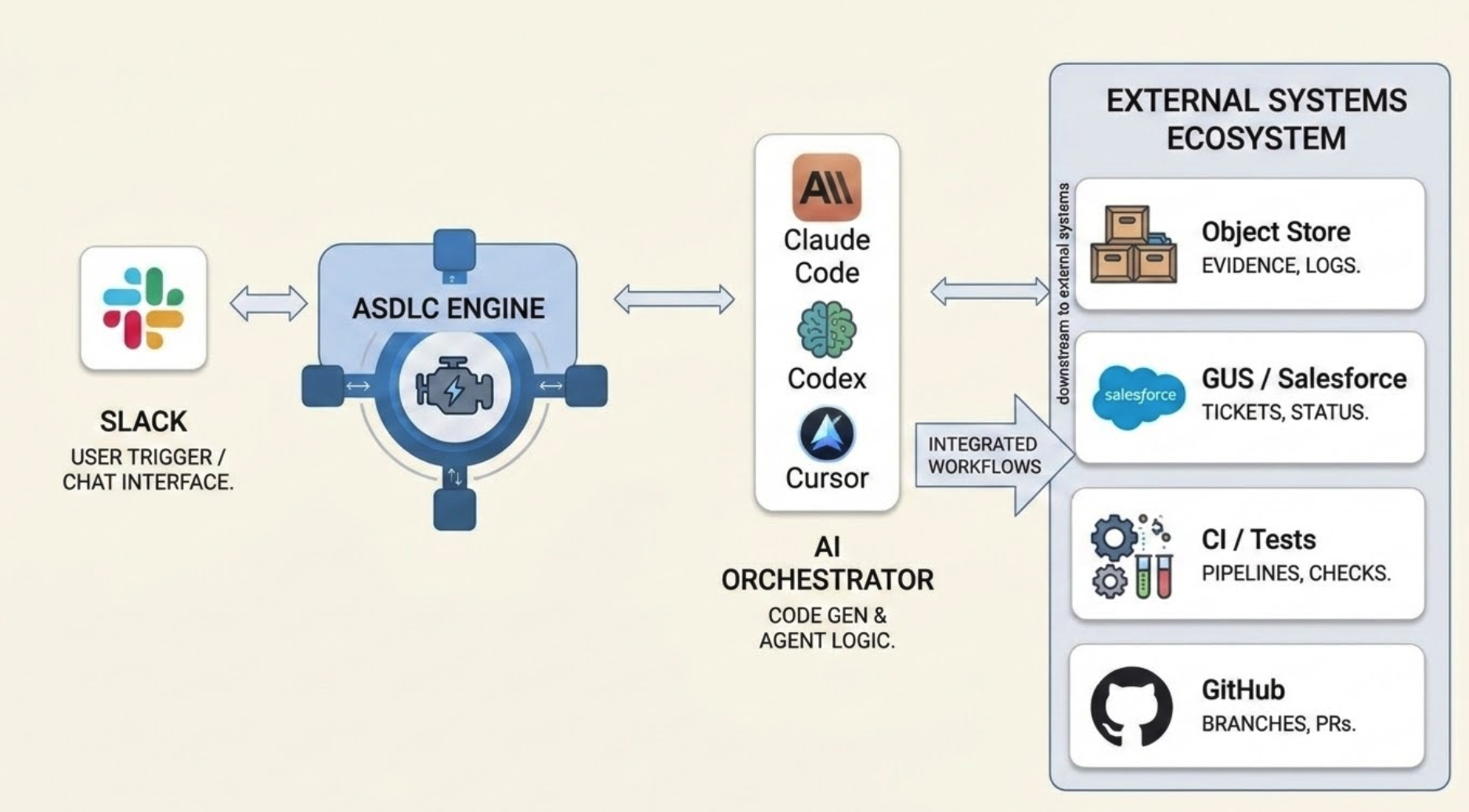
Slack-Native SDLC Command Center

One channel. One Canvas. From idea to production.

A product owner, engineer, or leader collaborates in a single Slack channel. Claude Code orchestrates the right agents in a sandbox, agents update GUS, GitHub, Salesforce, and Canvas, and humans approve the gates that matter — with every action leaving sanitized, auditable evidence.

Slack-Native SDLC Command Center — Agentic SDLC north star

Agentic SDLC component architecture — the operating loop

💬 Slack as the Cockpit

Humans see, decide, and approve in the project channel and Canvas. No IDE access required to lead a release.

🤖 Claude Code as the Engine

Personas, skills, and MCPs are loaded on demand. The sandbox is where the work actually happens.

🔒 Gates That Stay Human

11 named approval gates across SDLC and incident paths. Agents pause; humans decide; completion cards name the next owner.

📊 Evidence by Default

Canvas, GUS, Project Canvas, PRs, and sanitized telemetry leave a durable trail for audit and process mining.

Governance
11 gates
Slack-first, human-approved
Quality
Continuous
Judge sidecar + L3 mocked runs
Scale
SF + Full-Stack
One operating model, many stacks

Process Mining and Continuous Improvement

The biggest strategic value is measurable SDLC improvement

What Telemetry Captures

Cycle time by stageFlow
Gate wait timeFlow
Approval latencyFlow
Design rework rateQuality
Defect injection rateQuality
Test coverage by ACCoverage
Deployment lead timeDelivery

Patterns Leadership Can See

  • Which gates are slow?
    Identify approval bottlenecks
  • Which teams have high rework?
    Target design or requirements improvement
  • Which features stall in verification?
    Rebalance test strategy
  • Which artifact gaps cause defects?
    Strengthen upstream checks

Real Telemetry

Apex Quote Migration • W-22251293
14
EVENTS
5
AGENTS
2
GATES OK
6
CANVAS UPD
6
TEST CASES
1
BLOCKER
FEATURE FLOW
Kickoff Canvas G1 ✓ Arch G3 ✓ SDD+TDD Test • 6 Review Impl • 5 files 🚨 npm-auth
KEY TAKEAWAYS
Gate latency: 1 min — no approval bottleneck
🔎 1 blocking issue caught in test review before code
🚨 npm-auth blocker surfaced at build, not deploy
🔒 All 14 events sanitized — no PII or secrets

One feature, 14 JSONL lines. Multiply across a sprint and you get cycle time, gate bottlenecks, blocker aging, and Canvas discipline — all from structured telemetry agents emit automatically.

Future Expansion

Good expansion paths once the foundation is proven

Slack-Triggered Remote Orchestration

Claude Code SDK sessions launched from Slack actions. Full remote execution with sandbox isolation.

Platform

Process Mining Dashboard

Visual analytics from .asdlc/telemetry. Cycle time, bottleneck detection, and flow efficiency metrics.

Analytics

Quality Scorecards

Per-feature, per-team, and per-release quality scores derived from telemetry, coverage, and defect data.

Quality

Automatic Bottleneck Detection

Proactive alerts when gate wait times, blocker aging, or rework rates exceed thresholds.

Operations

Better Canvas Automation

Structured handoff cards, richer Canvas sections, and deeper integration with Slack workflows.

Platform

Release Readiness Analytics

Automated readiness scoring based on coverage, test evidence, review status, and blocker state.

Quality

Policy-as-Code Gates

Security, PII, coverage, and deployment readiness checks enforced as programmable gate conditions.

Governance

Agent Maturity Model

Track agent adoption and effectiveness by team or portfolio. Identify where to invest in skill or workflow improvements.

Governance

With Gratitude

Contributions & Acknowledgments

Agents SDLC Foundational Framework

This framework owes a great deal to the leaders and peers who shaped it. I’m grateful for the trust, the candor, and the partnership behind every decision — and for the room to take an idea and turn it into a working operating model.

Leadership Guidance
Anish Joyson
Strategic Direction

Strategic direction and reviews that shaped the framework — guidance that turned an early idea into a coherent operating model.

Lead & Framework Author
Praveen Kumar Patha
Design · Architecture · Implementation

Design, architecture, implementation, and documentation of the Agentic SDLC framework.

With Thanks To
Rakesh Tigulla
Support · Review · Feedback

Support, review, and feedback that sharpened the details and kept the framework honest at every iteration.

Built together. Shipped together. Improved together.

— Agents SDLC Foundational Framework

1 / 13